top of page
Brand Logo Complexity Project
TASK
Brand logo is an important component of brand equity and plays a crucial role in brand recognition. However, whether visual complexity of brand logos influences consumers' aesthetic perception has never been systematically explored. This project therefore examined aesthetic perception of different aspects of logo complexity and how they potentially differed.
PROCEDURE
A survey of 358 respondents on M-Turk was conducted to examine aesthetic perception of different dimensions (detail, dissimilarity, object irregularity, irregularity of arrangement, quantity, and symmetry) of logo visual complexity. Respondents were asked to rank based on their aesthetic perception the order of a list of brand logos with different levels of visual complex

FINDINGS
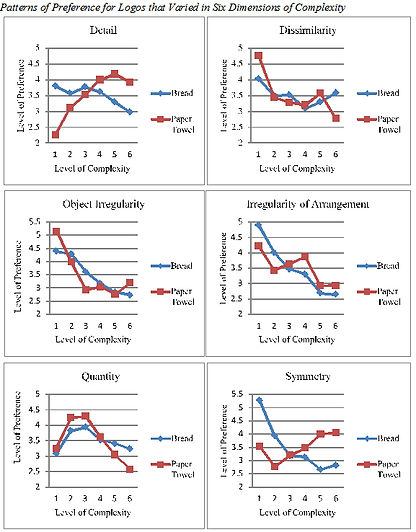
Findings showed that for "item-specific variety" (i.e., visual complexity reflected at the amount of visual elements, which includes detail and quantity) peaked at a certain level of complexity and then dropped; whereas preference for "relational variety" (i.e., visual complexity reflected at the spatial relationships between visual elements, which includes dissimilarity, object irregularity, arrangement irregularity, and symmetry) decreased as complexity increased (see figure below). This finding indicates that logo can be aesthetically more pleasing if it has medium level of visual elements and more organized relationships between elements.
bottom of page